
Collection: 2025.9.24 About Green Zircon
Good morning!
It's Nori-chan.
This installment of the "5-Minute Read Time-Killer Series" is about "Green Zircon."
In this content, I'd like to briefly explain zircon in general.
The image below shows zircons of various colors, such as the deep blue "Ratanakiri Blue" and purple zircon.

Zircon, known in Japanese as Hyacinth (風信子石), is a mineral belonging to the silicate group. It is widely distributed in rocks, regardless of size, but the sources of gem-quality zircon are somewhat limited.
Have you seen it in some article? You might hear "the oldest mineral in the world~," but this refers to Australian zircon and does not apply to all zircons.
It has a relatively high Mohs hardness of 7.5, and its specific gravity is comparable to or slightly heavier than sapphire (more on this later).
As its name suggests, zircon is a mineral containing zirconium (Zr), but there is also a red variety called hafnon, where zirconium is replaced by hafnium (Hf).
Since they are relatively similar, elemental substitution is possible.
Perhaps that red zircon you have might actually be hafnon, mineralogically speaking.
The photo below shows the "doubling effect" that will be discussed in the next section. The facets on the crown side are clear, but the lines of the back facets are blurry. This is not due to poor faceting technique, but rather an optical phenomenon.

One of zircon's characteristics, along with its history as a diamond substitute, is the "doubling effect."
This is a phenomenon where the facets on the pavilion side appear double due to birefringence.
This effect, like in sphene, combined with its inherent strong brilliance, makes it appear even more dazzling, creating a truly brilliant sparkle.
The image below is a zircon that is a prime example of the next topic, "metamictization."
Although the refractive index itself is much higher than ordinary minerals even with advanced metamictization, after seeing a typical heated zircon, it appears several steps less brilliant.
The doubling effect is also weaker.

Zircon undergoes metamictization because it contains trace amounts of radioactive elements.
Within zirconium itself, there are radioactive isotopes that are radioactive zirconium.
The process used to somewhat repair this metamictization, and also to improve the color itself, is "heat treatment."
The image below shows zircons that have undergone "heat treatment", which will be discussed in the next section. They exhibit beautiful brilliance and varying hues. The method of heating can also cause differences in color.

It can be turned blue at 800-1000 degrees Celsius, and colorless at higher temperatures.
This heat treatment, similar to the heat treatment applied to corundum and the impregnation treatment applied to emeralds and red beryls, is not considered a value-detracting treatment.
The image below shows a blue zircon with high-type characteristics and a low-type green zircon where doubling is not visible, which is important for visual identification in the next section, "Types."

Zircon is generally divided into roughly three stages—low-type, intermediate, and high-type—based on the progression of metamictization.
Metamictization is the long-term, slow destruction of the structure by radioactive elements, and as it progresses, its mineralogical and optical values also change.
There isn't a strict definition (though there are established numerical values for each), but heat treatment causes the crystal structure to recover, resulting in a high-type, while green zircon is generally considered a low-type.
Radioactive minerals containing radioactive elements often exhibit green, brown, or black colors.
Mainly, stones with high optical values during gemological examination are classified as high-type, so it would be a case of "examination → numerical type classification."
It's not a very simple distinction, but try looking at your zircon with a loupe or similar tool. The intensity of doubling is one indicator.
And not all green zircons are low-type; intermediate and, rarely, high-type specimens also exist.
An interesting anecdote is that since heating causes changes in color and type, low-type green zircons are often heated to improve their gem quality, which makes green zircon a rare color category.
A similar story applies to zosite (tanzanite).
Low-value colors of zoisite, such as brown, are heated to transform them into tanzanite, increasing their value. Thus, there is a paradox where a low-value color becomes a rare color.
The image below shows the 3.649ct green zircon featured this time.
It has good brilliance and color, and is believed to be an intermediate type.

The green zircon we are mainly introducing this time is unheated.
Unheated green zircon, in particular, often has a relatively advanced degree of weathering due to metamictization, which negatively affects its brilliance.
Also, although there are individual differences, I've heard that unheated green zircon is generally very difficult to cut and polish.
However, the piece we are introducing this time is a rare gem with strong brilliance, good color and hue, and a beautifully finished cut.
This time too, we are featuring zircon, so please enjoy its sparkle firsthand.
It is with sparkling minerals like these that good cuts bring out an overflowing brilliance.
You can definitely enjoy it in your room, in the sunlight, or even when you're out and about.
-
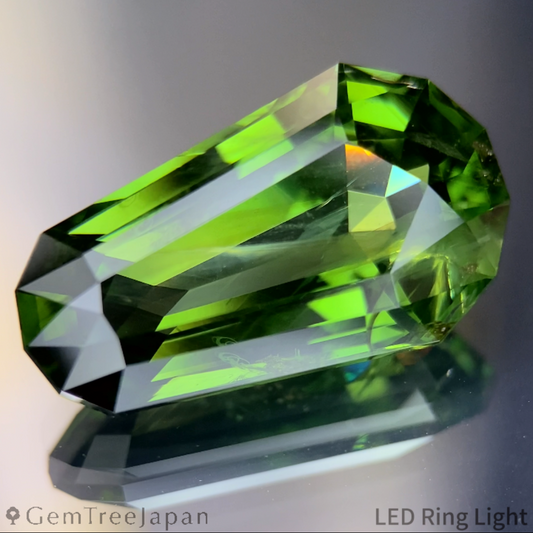 Sold out
Green Zircon 11.489ct / Madagascar
Regular price ¥540,000Regular price -
 Sold out
Green Zircon 3.649ct / Madagascar
Regular price ¥450,000Regular price -
 Sold out
Green Zircon 2.599ct / Sri Lanka
Regular price ¥180,000Regular price -
Greenish Yellow Zircon 1.283ct / Sri Lanka
Regular price ¥81,000Regular price -
Yellowish Green Zircon 1.113ct / Sri Lanka
Regular price ¥29,700Regular price¥64,800Sale price ¥29,700Sale


